Connecting Your Claude to Your Live Business Data
How we connect the AI agent your team already uses to your live business data, securely and reliably.
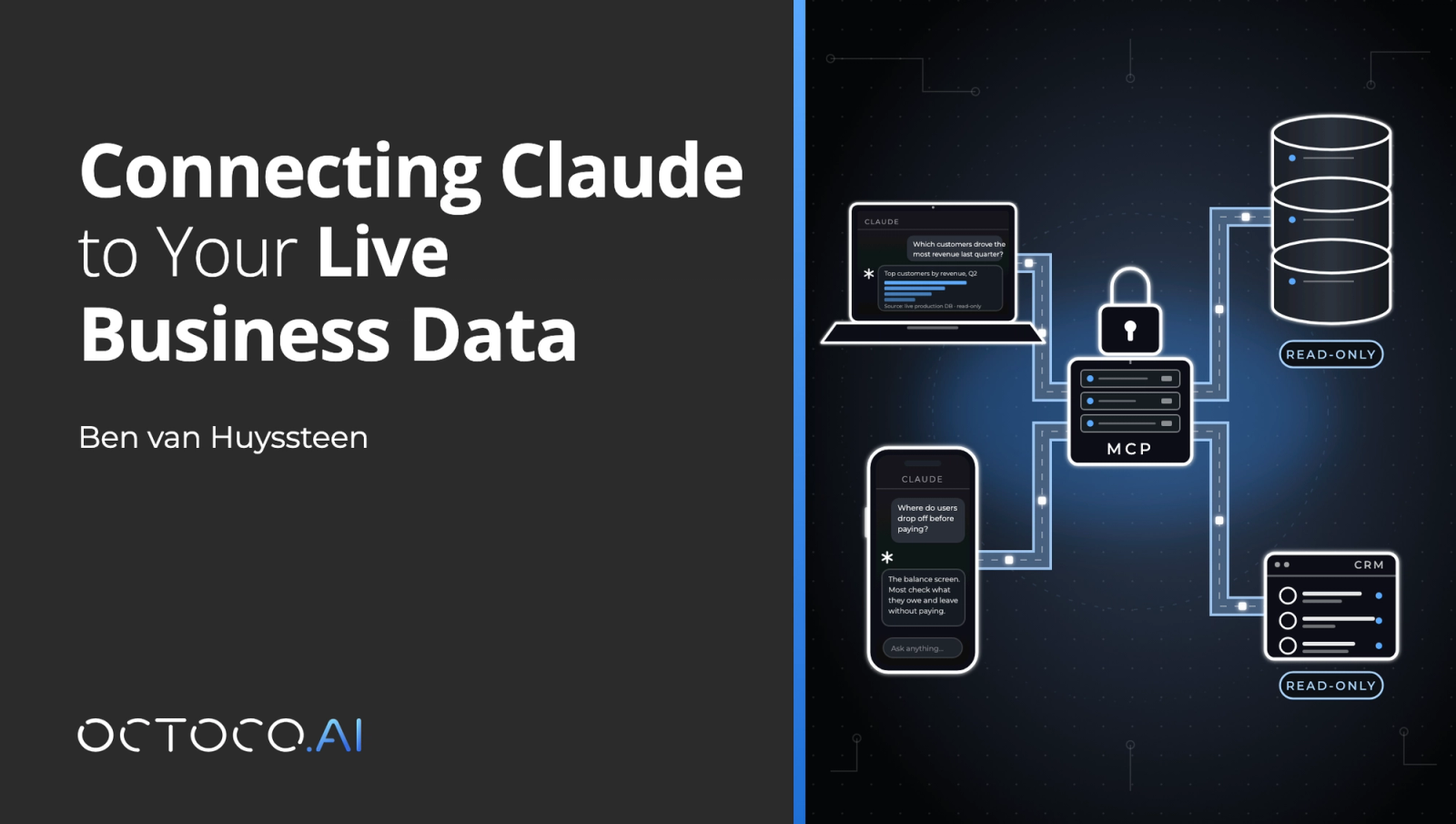
You need an answer to a specific business question. Which customers drove the most revenue last quarter? A graph of the five best-selling products in June. A detailed report on repeat-purchase behaviour since the loyalty programme launched.
So you ask the data analyst. Three days pass. They've had to re-familiarise themselves with the database schema, write and rewrite the query, then realise halfway through that part of the answer lives in the CRM and wait on the person who owns that system. Finally, the numbers arrive in a tidy report. By then you've moved on, and you have ten new questions, while Claude sits open in another tab, unable to help.
Sound familiar?
This is the gap almost every business lives with: executives and teams need real-time answers grounded in their own data, but the only route to those answers runs through a slow, manual and often costly chain. The data is there. The AI tools are there. They just aren't connected.
We've built that connection. We securely link the AI agent you already use — Claude, ChatGPT, or anything that speaks MCP — directly to your business data. You ask in plain English and get an instant, true-to-source answer from your live production data, whether it sits in an on-prem PostgreSQL database, a CRM, an internal API, or all three. And when one question spans several systems — revenue in the database, the customer's history in the CRM — the AI can query them all and put the pieces together, in the same conversation. No new dashboard, no queue behind an analyst. You get answers through the tools your team already uses every day.
How Shap-Shap's founder became his own data analyst
Shap-Shap lets residents pay their municipal rates, water and electricity through a single WhatsApp conversation, with no app to install and no data cost. In rural towns, where a trip to the municipal offices can cost more than the bill itself, that matters.
Founder Ben Lindeque runs Shap-Shap with a small team, which means he is the sales, partnerships and support desk on most days. A young business like that generates data from all directions: property registrations, incoming EFTs and their allocations, a chatbot running in three languages. Each question he wanted answered meant paying for an engineer's time and waiting days. For a busy founder wearing three hats at once, the smaller questions went unasked.
We connected Shap-Shap's database to his Claude. Ben just needed to start asking those questions.
One from this morning: where in the WhatsApp flow do registered users stop before paying?

The biggest leak was the balance screen: hundreds of people a month check what they owe and leave. Ben assumed they were customers who had already paid, so he asked: have the balance-checkers ever paid through Shap-Shap? Half never have. These are new prospects, so the pay option belongs on the balance screen. Two questions, and what looked like a retention problem turned out to be a UX fix.
"This tool completely changed the game for me. Being able to ask your data questions in plain English, or even Afrikaans, and gain insights immediately is incredibly valuable, especially to a decision-maker without the technical know-how." — Ben Lindeque, founder, Shap-Shap
How it works

Several modular parts make up the system; the first is the fail-safe standing behind all the others.
Read-only connection. We connect every source read-only at the source itself: a read-only database account, a scoped API key, a viewer permission. Your own systems enforce that boundary; our software cannot override it. Even if everything above it failed, nothing could be written or changed.
Network path. The private, encrypted route to your data, designed with your IT team. The credentials it uses live in a secrets vault inside your account and stay there. The only thing that leaves is the answer to a question an authorised user asked, delivered to the AI tool they use.
MCP server. A small server deployed next to your data, in your own cloud account, or wherever works best for your setup. It speaks MCP, the open standard that Claude, ChatGPT and most agent frameworks already understand, so there's no new software for your team to install. The connection appears in the tools they already use, behind your own sign-in.
Purpose-built tools. The server exposes a focused set of tools, each shaped to its source: what it can query, how much it returns, and how the AI should use it. Each tool's notes say what the other sources hold, so a question spanning your database and CRM gets answered across both.
Access. Everyone signs in through your existing identity provider, and permissions follow your existing groups. Finance sees the finance tools, support doesn't.
Audit. Every question is logged: who asked, which tool, when, and whether it succeeded. When someone asks how a number was produced, you can show them.
Why it can't be plug-and-play
Real business data doesn't sit somewhere convenient. It lives on-prem, or in a managed cloud database, or behind a CRM, or scattered across documents in a shared drive — often several at once, on different engines. And reaching it safely is a different problem at every business: one environment needs a VPN, another a whitelisted IP address, a third has no public endpoint at all. Credentials are a second problem: each connection needs its own correctly-scoped credentials, not an admin login pasted into a config box. There is no setting that covers all of this, and getting it wrong fails in one of two ways: a connection that doesn't work, or one that's open to more than just the MCP server.
The people side is just as real as the technical one. Setting this up starts with a conversation with your DBA and IT team, not a signup form. They know your environment, they decide what's reachable, and they know which data is actually worth exposing. You end up with a connection built for your environment, signed off by your own IT team.
The right answer, not just an answer
Connecting an AI to your data is only half the job; the harder half is trusting what comes back. Raw schemas don't explain a business. Nothing in the database says that transactions_v2 is current and transactions went stale in 2022, that amounts are stored in cents, that status 4 means refunded, or which of two similar-looking customer tables is the real one. Every business has a layer of knowledge like this, and it usually lives in one analyst's head. A model without it doesn't hesitate or warn you. It reads the stale table, reports cents as rands, and presents the result as fact.
So we write it down. Each connection ships with curated notes, built by going through the actual data with your team: which tables to trust, how money and identity are stored, what the codes mean, where the traps are. The AI reads these notes before it queries, so the institutional knowledge gets used on each question instead of sitting in someone's head.
At handover, we build an eval suite with your team: real business questions with known-correct answers, run against the live system. Accuracy is demonstrated, not asserted. And because schemas drift and models change, the evals can be re-run over time, so the AI's understanding of your systems stays current rather than frozen at launch.
Getting started
You don't need a data team, a warehouse, or perfectly clean data — Shap-Shap had none of those. You need two things: questions worth asking of your data, and someone who holds the keys to it, whether that is your IT team, your DBA, or whoever runs your systems.
The first conversation is short and practical: which systems hold your data, who should be able to ask questions of it, and what your environment looks like. From there we connect securely, curate the notes that make answers correct, verify with evals built alongside your team, and hand over. Timing depends on your environment and how fast access is arranged. Expect weeks, not months.
If you've read this far, you probably already have a question you'd like to ask your data. Get in touch — the first conversation costs nothing, and you'll leave it knowing exactly what this would look like in your business.